Iboga Microdosing & TBI: A Six-Week Case Study
This article follows an individual living with the long-term effects of a traumatic brain injury (TBI) across a six-week iboga microdosing journey, during which I provided education, ongoing support and psychological integration.
At the outset, three intentions were identified for the experience: clarity, embodiment and direction. Alongside these, we were curious about whether any changes might be noticed in difficulties associated with the TBI, particularly around attention, executive functioning and general wellbeing.
To help track the experience, we used regular conversations throughout the six weeks alongside a Brain Health & Wellbeing Profile covering cognition, executive functioning, emotional wellbeing, identity and self-understanding, and general wellbeing.
What emerged over the following weeks was broader than cognitive change alone.
While there were indications of changes in attention and goal-directed behaviour, some of the most prominent developments were psychological and emotional. The journey involved revisiting the impact of the TBI, becoming increasingly aware of bodily and emotional experiences, questioning how the injury had shaped identity, and ultimately describing greater understanding and self-compassion.
Before beginning, three words were identified to orient the experience.
Clarity. Embodiment. Direction.
They were deliberately broader than clinical outcomes. Clarity represented a desire for greater self-understanding and a clearer understanding of personal circumstances. Embodiment reflected an interest in connecting more deeply with bodily and emotional experience. Direction related to a larger question about where life and work were heading.
Over the following six weeks, those three intentions would become surprisingly representative of what unfolded.
Clarity
Rather than arriving as a simple answer about what the TBI had changed, clarity seemed to emerge through a changing understanding of the injury and its place within the individual's identity.
A recurring difficulty was not being able to easily distinguish between the effects of the TBI and other aspects of the self. Were difficulties with emotional reactivity, attention, work and relationships consequences of the injury? Were they connected with earlier experiences? Or were they simply aspects of personality?
One analogy captured this difficulty particularly well: the TBI was described as like wearing a pair of glasses that could never be removed. There was no unaffected version of the self available for comparison.
This uncertainty extended into questions around disability and disclosure. There were reflections on occasions when the TBI had not been disclosed professionally and whether greater acknowledgement might have allowed access to appropriate support. At the same time, disclosure carried its own concerns.
Previous experiences had created an awareness that labels could influence how other people interpreted the individual. There were occasions when emotional reactions had been attributed to the brain injury, alongside experiences of being categorised in ways that did not necessarily reflect the individual's own self-understanding.
By the end of the six weeks, there was still no definitive answer about which aspects of life could be attributed to the TBI, and which could not. What appeared to change was the relationship with that uncertainty. Increasingly, the conversations centred around processing the impact the injury had had on life and developing greater self-compassion.
Perhaps clarity, in this context, wasn't about perfectly separating the injured brain from the person. It was about developing a clearer and more compassionate understanding of the person living with the injury.
Embodiment
Of the three intentions, embodiment became perhaps the most visible throughout the six weeks.
Early in the programme, there were reports of vivid dreams, changes in energy and increased awareness of bodily sensations. As the weeks progressed, these experiences became more pronounced. During a grief group, crying and shaking were experienced and understood as the release of previously held emotional material. Similar experiences occurred independently after journaling and during periods of reflection.
Eventually, some of this material became connected with the TBI and the accident surrounding it. When exploring the experience, fear and sadness became particularly prominent. There was reflection on emotions that, at the time of the accident, may not have been possible to understand or express.
These experiences did not occur in isolation. There was already an interest in somatic approaches and previous experience of therapeutic and body-oriented work. During the six weeks, however, there appeared to be an increasing pull towards understanding these experiences through the body rather than purely through cognitive analysis.
What can be said is that during the microdosing period, there was increased somatic and emotional awareness, with several significant bodily-emotional experiences being associated with the journey. For someone who had chosen embodiment as one of the three intentions before beginning, this became a particularly prominent aspect of the experience.
Direction
The third intention, direction, developed differently. There was no sudden revelation about what to do next. Instead, the six weeks appeared to involve a broader re-evaluation of work, capability, achievement and what might be wanted from the next stage of life.
Professional direction became a recurring topic. Existing skills, public speaking, coaching and other possible avenues were explored, alongside questions around confidence and how previous working experiences may have been influenced by the TBI.
By the later stages of the journey, some of this exploration was beginning to translate into action. Following a successful professional speaking engagement, an idea began to develop around offering educational webinars, with some of the practical infrastructure starting to be put in place.
At the same time, uncertainty remained.
Another revealing conversation concerned achievement more broadly. Sport had previously provided a relatively straightforward measure of progress and success. Reflection on changing expectations and different stages of life led to consideration of where that sense of achievement might now be found elsewhere.
Direction therefore did not emerge as a clear instruction about what to do. Instead, it seemed to involve reconsidering where capability, achievement and meaning could be expressed moving forward.
The Brain Health & Wellbeing Profile reflected some of that ambiguity. Sense of purpose and direction increased, as did the feeling that life was moving in a positive direction. Yet confidence about the future remained unchanged. There appeared to be more movement, without necessarily more certainty.
Neuropsychedelics Brain Health & Wellbeing Profile
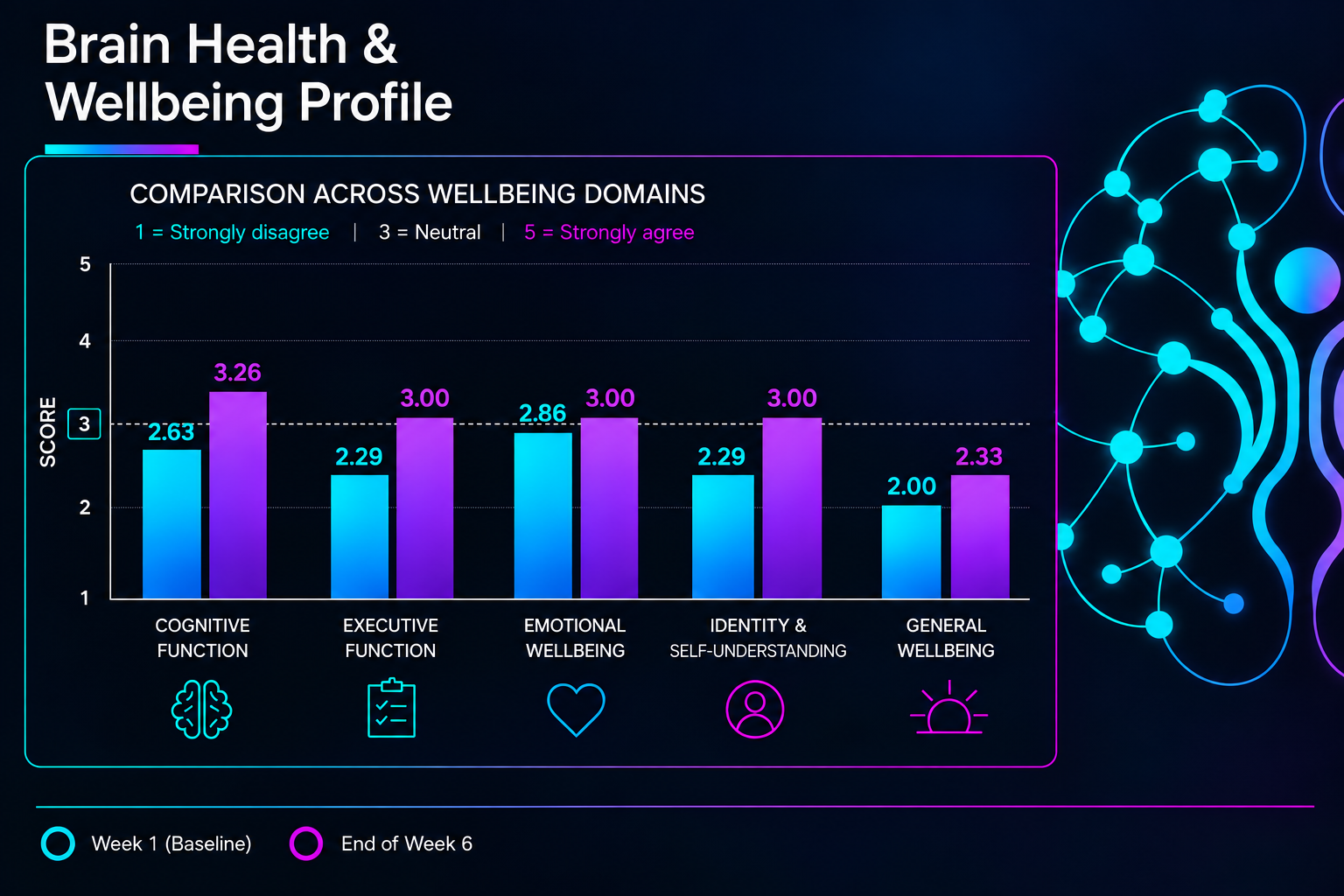
To complement the weekly conversations, the Brain Health & Wellbeing Profile was completed before and after the six-week journey.
The profile was developed as a structured monitoring tool rather than a validated clinical outcome measure. The scores are therefore presented descriptively, as another way of understanding the experience rather than as evidence of efficacy.
The clearest changes were in staying focused on tasks and conversations (2 → 4) and working towards important goals (2 → 4).
Smaller increases were seen across planning, task initiation, mental stamina, confidence, self-compassion, understanding the impact of the TBI, sense of purpose and the feeling that life was moving in a positive direction.
Importantly, the pattern was not uniformly positive. Task completion, emotional regulation, positive mood, overall quality of life and confidence about the future remained unchanged.
This mixed picture broadly reflected what emerged through the weekly conversations. There appeared to be specific changes in attention, goal-directed behaviour and self-understanding, alongside areas of continuing difficulty and uncertainty.
Integration: Coming Home to the Self
The journey began with three intentions. Six weeks later, none had produced a simple endpoint.
Clarity did not mean having every answer. Embodiment sometimes meant encountering difficult emotions rather than escaping them. Direction meant beginning to explore possibilities rather than knowing exactly what would come next.
By the end of the six weeks, there appeared to be a subtle shift away from focusing primarily on what was wrong and what needed fixing, towards understanding what had happened, how those experiences had shaped the individual, and how to work with the person that exists now.
Going into this six-week journey, I was particularly curious about whether we might observe changes in areas such as executive functioning, attention and emotional wellbeing. However, this case was not designed to answer questions about cognitive efficacy, and the monitoring used here cannot tell us whether iboga produced objective neurocognitive improvement.
What I found more interesting, looking back, was how quickly the experience became about something much broader than cognition. The process appeared remarkably holistic. Rather than focusing narrowly on the difficulties associated with the TBI, it moved through emotion, the body, relationships, identity, purpose and ultimately the individual's relationship with the self. In that sense, the experience did not necessarily look like an “iboga journey for brain injury”; it looked like a deeply personal iboga journey undertaken by someone who happened to be navigating life with a TBI.
For me, this raises an important question about how we conceptualise recovery. Cognitive and executive improvements would clearly be valuable, and they remain an important area for future investigation. But recovery after TBI is not solely about improving attention, memory or executive function. Understanding who you are after an injury, making sense of what has happened to you, accepting the parts of yourself that may have changed, and developing greater compassion towards yourself may be equally meaningful aspects of recovery.
This is also something I have encountered before. In my previous qualitative research exploring psychedelic experiences following brain injury, I initially approached the subject with considerable interest in cognitive changes and trauma-related symptoms. Yet themes around identity, insight, self-understanding, acceptance and self-compassion became some of the most striking aspects of participants' accounts. Seeing similar themes emerge again here has reinforced my interest in this less easily measured side of psychedelic experiences following brain injury.
There is something about the idea of “coming home to the self” that increasingly resonates with me when listening to these experiences. Across the stories I have encountered, there seems to be a recurring movement towards understanding the self with greater clarity and, sometimes, greater compassion. In this case, iboga did not appear to provide simple answers to every difficulty associated with TBI. What it seemed to facilitate was a process of looking inward, making sense of what had been carried, and beginning to relate differently to the person carrying it.