Iboga and the Dopamine Train: Rethinking ADHD in an Age of Overstimulation
Before getting into this, I should say that I’ve intentionally avoided doing a deep dive into the research while forming these initial thoughts. I wanted to follow the question organically, based on my own observations and experience, rather than immediately filtering it through existing explanations.
ADHD is now one of the most widely recognised neurodevelopmental diagnoses, particularly in children and young adults. Although descriptions of inattentive and hyperactive behaviour existed long before the internet, ADHD became increasingly prominent as a diagnostic category from the late twentieth century onwards, the same broad period in which daily life became progressively more saturated with television, gaming, smartphones, social media and on-demand stimulation.
That creates an obvious causal problem. Does a highly stimulating environment contribute to the attentional patterns we now label as ADHD, or are people with pre-existing ADHD traits simply more drawn to stimulation? The answer may be both, and separating cause from effect is difficult.
What is also important is that there is no single accepted biological abnormality that defines ADHD. Research has identified genetic associations and group-level differences in brain function and neurotransmitter systems, but there is no single neurological lesion, biomarker or confirmed dopamine deficiency that can be used to explain or diagnose the condition.
Unlike many medical conditions, ADHD is not diagnosed through a biological test. There is no scan, blood marker or single neurochemical abnormality that confirms its presence. Diagnosis is instead based on patterns of behaviour, attention and impairment.
That does not make those experiences any less real, but it does leave open an important question: could different underlying causes produce a very similar outward pattern? In other words, might some people arrive at what we call ADHD through very different routes?
I want to leave that uncertainty open and ask what happens if we temporarily look at ADHD not as a fixed neurological disorder, but as a behavioural pattern that may be shaped, at least in part, by the environment around us.
Dopamine Train
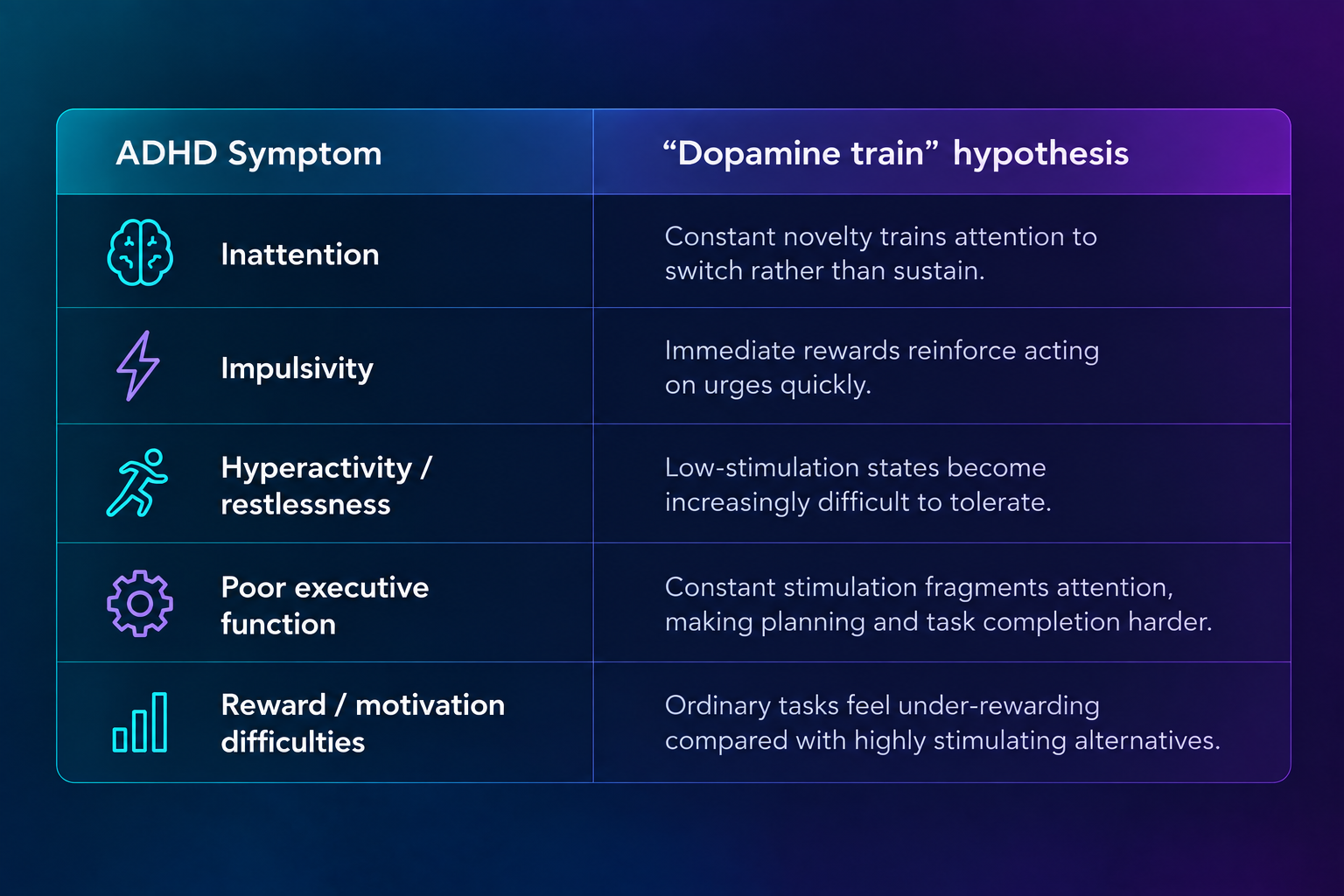
Modern life is built around repeated reward cues. We wake up and check our phones, move between messages, news, social media, music, food, caffeine, notifications and entertainment, often within minutes of each other. Much of this behaviour is reinforced by novelty, anticipation and immediate reward, all processes in which dopamine plays an important role.
Over time, this can create a pattern of constantly seeking the next small hit of stimulation. We switch tasks quickly, reach for our phones during moments of boredom, struggle to sit with low-stimulation activities, and become increasingly accustomed to immediate feedback. Rather than seeing this as an inevitable feature of modern life, I think it is more useful to ask whether our attention and reward systems have been progressively hijacked by environments designed to keep us engaged.
The pattern can become remarkably automatic. A moment of boredom appears, and the hand reaches for the phone. A video loses our attention within seconds, and we swipe to the next one. We eat while watching something, check messages while working, and increasingly fill every quiet gap with stimulation. In behavioural terms, we are repeatedly rehearsing the same loop: discomfort or boredom, seek stimulation, receive an immediate reward, repeat.
My question is what happens when that loop is practised thousands of times over years. If sustained attention, boredom tolerance and delayed gratification are used less, while rapid switching and immediate reward are reinforced constantly, it seems reasonable to ask whether attention itself begins to adapt to that environment.
The question is what that does to us over years, and whether, in some people, the resulting patterns of attention, motivation and impulse control begin to look remarkably similar to what we describe as ADHD.
The mainstream response to these behaviours is often medication. Stimulant medications such as methylphenidate and amphetamines work in part by increasing dopamine and noradrenaline signalling, making it easier to sustain attention, regulate impulses and engage with tasks that might otherwise feel under-stimulating.
That raises an interesting tension for me. If part of the problem is an increasingly dysregulated relationship with stimulation and reward, are we addressing the underlying pattern, or helping people function within it by increasing the same neurotransmitter signalling involved in motivation and reward? In simple terms: are we trying to solve dopamine-driven behaviours by giving the system more dopamine?
That leads to a different treatment question. If at least part of this pattern has been learned through repeated exposure to stimulation and immediate reward, then perhaps the goal should not only be to help someone function better within that environment, but to change their relationship with stimulation itself.
What would happen if the compulsive pull toward novelty, reward and constant input could be interrupted long enough for attention, motivation and impulse control to reorganise around a lower-stimulation baseline?
Ibogaine
Iboga and its principal alkaloid, ibogaine, are best known for their unusual effects on addiction and compulsive behaviour. What interested me personally was not simply the reduction of one specific habit, but a broader quietening of the drive toward stimulation. Impulses felt less compelling. There was more space between urge and action. Low-stimulation states felt easier to tolerate, and sustained attention seemed to require less effort.
What makes iboga particularly interesting in this context is that its effects appear to reach beyond a single substance or behaviour. In addiction settings, people often describe a broader interruption of compulsive patterns, cravings and automatic reward-seeking. That raises the possibility that iboga is not simply acting on one habit, but on the wider relationship between impulse, reward and behaviour itself.
That made me wonder whether iboga may be doing something more fundamental than suppressing individual behaviours. Perhaps, in some cases, it temporarily interrupts the learned relationship between reward, novelty and action, creating enough distance for the system to recalibrate.
If chronic overstimulation can help produce the pattern outlined above, then the obvious question is whether a compound known for disrupting compulsive reward-seeking could move some of those behaviours back in the opposite direction.
That is the hypothesis I find most interesting: not simply that iboga might “treat ADHD,” but that it might help reveal how much of the ADHD-like pattern is being maintained by a dysregulated relationship with stimulation, reward and impulse.
Ibogaine is already attracting growing interest for conditions involving addiction, compulsive behaviour and, more recently, brain injury, the latter being an area I am already exploring both personally and professionally.
What my own experience with Iboga has opened for me is another line of thought entirely: whether the same medicine that appears capable of interrupting deeply ingrained behavioural and reward patterns might also have something to teach us about attention, stimulation and the behaviours we currently group under ADHD.